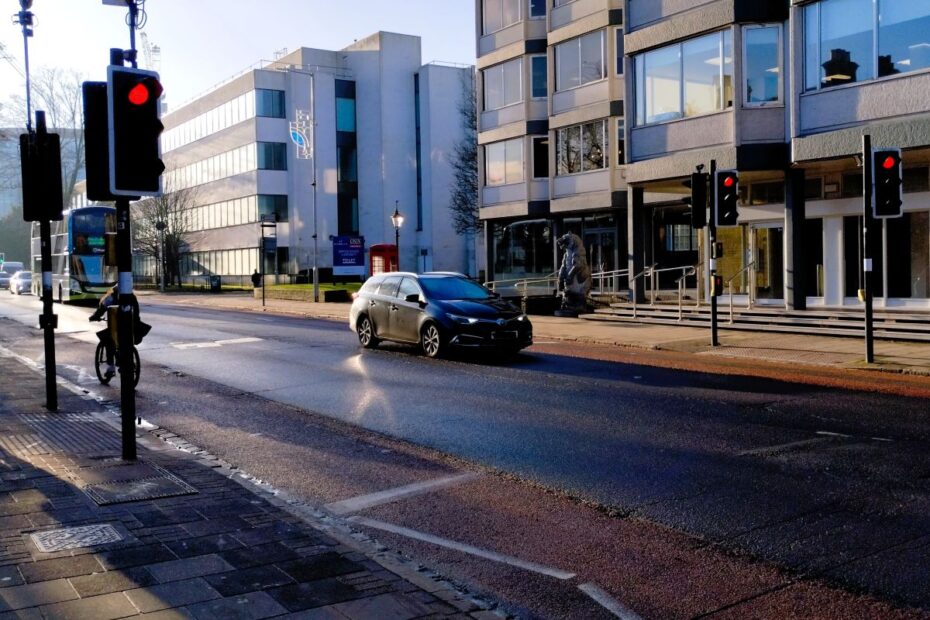
In the UK, there is a very specific kind of road rage that doesn’t involve shouting or honking. It is the silent, simmering fury of sitting at a Pelican crossing in a dead-quiet street, staring at a red light while the person who triggered it is already two streets away. If you’ve ever driven in a British town, you know the “Tyranny of the Yellow Button.” Here is why pedestrian traffic lights are the ultimate test of a driver’s patience:
The “press-and-dash”
This is the cardinal sin of the UK pavement. A pedestrian approaches the crossing and hits the button with the authority of a high-court judge. Then, they look both ways, see a gap in traffic, and cross immediately. By the time the lights actually turn red, they’ve reached their destination, and you—the driver—are left stopping for a “phantom” pedestrian.
The illusion of power
There is a certain type of person who treats the crossing button like a scepter. They don’t just press it; they claim it. They know that with one firm “click,” they have the power to halt a two-ton SUV and a line of thirty commuters. In that moment, they aren’t just a walker; they are the Master of the A-Road, and they will make you wait the full 20 seconds of the “Green Man” phase even if they’ve already finished their journey.
The “smart” lights that aren’t so smart
We were promised Puffin crossings—the “intelligent” ones with sensors that are supposed to cancel the request if the pedestrian walks away. In reality? Half of them seem to have a mind of their own. You still find yourself sitting at a red light, watching a plastic cone spin underneath the box (the tactile signal for the blind), while the only thing moving on the road is a stray crisp packet.
The 2022 Highway Code Legacy
Since the update to the Highway Code a few years ago, the “Hierarchy of Road Users” has given pedestrians even more priority. While it’s great for safety, it has emboldened the “Button Mashers.” They know the law is on their side, leading to a surge in people pressing the button “just in case,” crossing early, and leaving a trail of brake lights and frustrated sighs in their wake.
The Ripple Effect
One unnecessary stop at a pedestrian light doesn’t just affect one car; it’s a shockwave. In busy city centres, these “ghost stops” are the silent killers of traffic flow, turning a 10-minute commute into a 30-minute crawl, all because someone couldn’t wait 5 seconds for a natural gap in the traffic.
If just more people used their brain, before their finger, they could just cross a not too busy road without the need to press the button. They cross anyway because there was no need to press the button in the first place. Alternatively, in the 21st century, we could have truly smart crossing which will switch to green immediately when the road is free or if the person who pressed is not crossing at all.