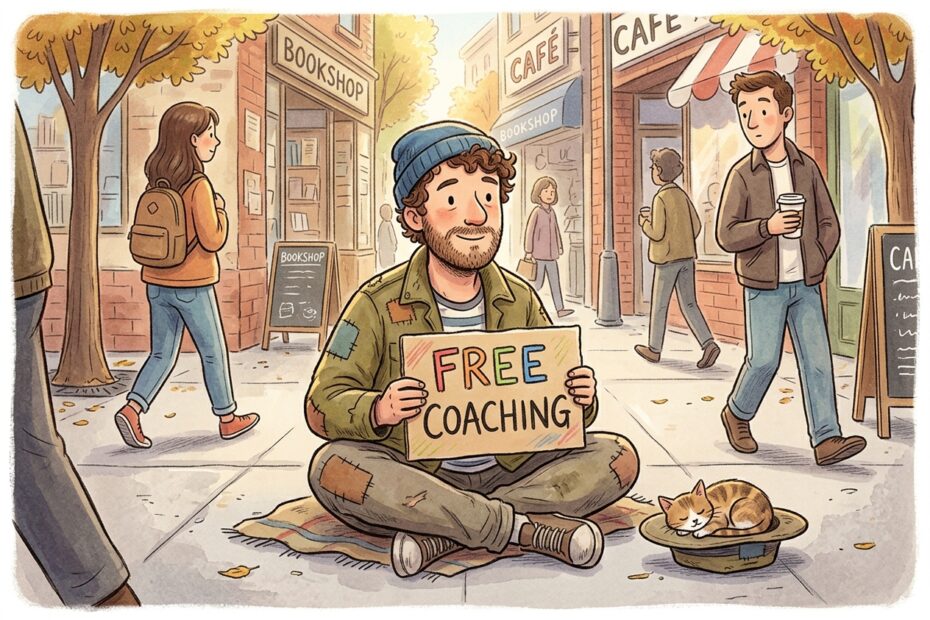
In our professional lives, we all have those moments where boundaries are tested. We’re at a nice business meeting, perhaps a prestigious club, enjoying a conversation that we believe is rooted in mutual professional interest. Then, the pivot happens. It often starts with a compliment, followed quickly by the dreaded request: “Could you do some pro-bono coaching for me?” Recently, I found myself in this exact situation. I was approached by a professional woman—someone clearly established in a senior role at a major local pharma company. She wasn’t struggling, she wasn’t between jobs, and she certainly wasn’t representing a charity. By her own admission, she was doing well. Yet, on the second question she asked me, she felt entirely comfortable asking for my expertise, my time, and my professional output for free. I’ll be honest: I felt insulted.
Defining the “pro-bono” boundary
It is important to clarify that I do offer pro-bono coaching. It is a part of my practice that I value deeply. However, my pro-bono work is reserved for charities and the dedicated committees of trustees who serve them—people who are often working tirelessly for a cause and operating on shoestring budgets. When I offer my skills for free, I feel it should be an act of genuine service to those who truly need it, or a contribution to a mission that transcends personal profit. It is not, and should never be, a discount service for those who simply prefer to keep their own money in their pockets while capturing the value of someone else’s work.
Why the Request Stung
The discomfort I felt wasn’t about the money itself; it was about the entitlement embedded in the request. When a successful professional asks a peer for free work, it implies a lack of respect for the years of training, the trial and error, and the hard-earned experience that makes that coaching valuable in the first place. It suggests that my professional output is a commodity to be sampled rather than a service to be invested in. I managed to keep a straight face—maintaining the decorum required for the setting—and politely clarified that my pro-bono work is strictly reserved for charitable organizations and those in genuine, desperate need. Unsurprisingly, the conversation didn’t go any further. There was no follow-up.
The Value of Reciprocity
We live in a culture that often encourages us to “hustle” and “leverage” our networks. But healthy professional relationships are built on reciprocity, not extraction. If you find yourself on the other side of this dynamic—perhaps feeling the urge to ask a connection for a favour—take a moment to consider these three questions before you speak:
- Am I in a position to pay for this service? If the answer is yes, then asking for it for free is not “networking,” it is simply asking for a handout.
-
Is this a fair exchange? If you are not offering something of equal value in return, you are asking the other person to subsidize your success.
-
Does this person have a public policy on pro-bono work? Respecting their professional boundaries is the best way to earn their respect in return.
Your expertise has value. Never be afraid to protect that value, and remember: true professionals understand that the best partnerships are the ones where both sides are invested in each other’s growth, not just one side’s wallet. What is your experience with boundary-setting in professional settings? Have you ever had to say “no” to a request that felt like an overreach?